Outdoor Christmas light timers, plugs and cords
Beautiful lights still look amateur if they are on at two in the afternoon, or fed by an orange indoor cord snaking across the lawn. Plan the power first: an outdoor-rated timer so the display runs itself, and cords sized for the load and the distance.
As an Amazon Associate, Christmas Lights North Atlanta earns from qualifying purchases. The product links on this page are affiliate links - it costs you nothing extra, and it does not change what we recommend.
Ask anyone who installs lights for a living what separates a professional display from a DIY one at a glance, and power routing will come up before bulb quality does. Not because the lights are different, but because the cords are visible, the timing is obvious, and both are usually improvised.
The good news is that this is the cheapest part of the whole job to get right.
Plan the power before you buy a single string
Work out three things in this order:
- How much the display draws. Bulb count times watts per bulb. Commercial LED C9 is about 0.96 watts a bulb, C7 about 0.6, and 5mm minis about 0.07. Divide the total by 120 to get amps.
- Whether that fits on one circuit. A 15-amp circuit should carry no more than 1,440 watts continuously. Most all-LED residential displays are comfortably inside that; large ones with wrapped trees are not.
- How far the cord has to run, and by what path. Measure the route the cord actually takes around the corner of the house, not the straight line across the lawn.
Our light planner does all three from the width of your house and tells you which cord gauge you need.
Cord gauge, quickly
16 AWG for a typical LED display. 14 AWG past 50 feet or above 5 amps. 12 AWG past 100 feet or above 10 amps. AWG runs backwards, so a smaller number is thicker wire.
Buy the length you need rather than the longest one in the store. A long cord coiled up beside the outlet under load is the one that gets warm, and the surplus has to go somewhere visible.
Color matters more than it sounds. Green cord disappears against grass and mulch; the standard orange contractor cord is the single most conspicuous thing in most DIY displays.
The GFCI thing
This is the most common call we get in a wet December: the lights keep tripping the breaker.
It is water in a plug-to-plug joint, sitting on wet ground, nine times out of ten. The fix is a couple of dollars: lift every connection off the ground and put it inside a weatherproof cover. Do that at the start and you will most likely never think about it again.
If it still trips after that, stop and find the fault. A GFCI that trips repeatedly on a dry, covered display is telling you something is damaged. That is the device working correctly, and the answer is never to bypass it. The full diagnostic order is on our GFCI tripping page.
Make it switch itself on
A display that comes on at dusk by itself looks intentional. One that depends on somebody remembering looks forgotten by the second week of December, and it always ends up on at odd hours at least once.
A photocell timer is the cheapest meaningful upgrade you can make to any display; it costs less than a single string of lights. If you have zones on different schedules, or you want to dim warm white down to something closer to a glow than a glare, a smart plug is worth the difference.
Timers: the cheapest upgrade to any display
A display that switches itself on at dusk looks intentional. One you have to remember looks forgotten by the second week of December. A photocell timer is the simplest version and costs less than a single string of lights.

Cheapest option that genuinely fits
BN-LINK Outdoor 24-Hour Timer With Photocell Light Sensor
The cheapest way to make a display look intentional: on at dusk, off after the hours you set, without you touching it. Two grounded outlets and a 15-amp rating covers a typical house.
- Dusk-to-dawn sensor
- ETL listed
- 15 A rated
$12.99
See it on Amazon
What we would put on this house
HBN Outdoor Light Timer, Dusk to Dawn Light Sensor Outlet,2 Grounded Outlet
A two-outlet dusk-to-dawn sensor at the low end of the price band. Does the one job a timer has to do.
- Dusk-to-dawn sensor
$12.99
See it on AmazonSmart plugs: worth it when you have zones
Once the roofline, the trees and the yard are on separate schedules, app control stops being a gadget and starts being the thing that makes the display manageable. One of these can also dim, which almost nothing else outdoors can.

Cheapest option that genuinely fits
Kasa Outdoor Smart Plug, Smart Home Wi-Fi Outlet with 2 Sockets, EP40
Two independently controlled outlets over Wi-Fi with no hub, rated IP64. Worth the extra over a timer when you have zones — roofline on one schedule, yard on another.
- App and voice control
- IP64 weather rated
- ETL listed
$17.28
See it on Amazon
What we would put on this house
Kasa Outdoor Smart Dimmer Plug
An outdoor dimmer, which almost nothing else on this list can do. Dimming warm white to about 70 percent is the difference between a display that glows and one that glares.
- App and voice control
- Dimmable
- IP64 weather rated
$17.99
See it on Amazon
Most capable, if the budget allows
SURAIELEC Outdoor Power Stake Smart WiFi Light Timer, 6 Outlets, Waterproof
Six outlets on a stake you push into the bed, so the whole yard runs off one cord back to the house. This is the part of a big display most people improvise badly.
- App and voice control
$29.99
See it on AmazonOutdoor cords, by gauge and length
Two rules we never break: everything outdoors is outdoor-rated, and every outdoor circuit is on a GFCI outlet. For an all-LED display 16 AWG is plenty; step up to 14 for long runs or any incandescent load. Buy the length you need rather than coiling fifty feet of surplus by the outlet.
| Product | Outlets | Length | Gauge | Control | Price |
|---|---|---|---|---|---|
| Amazon Basics 50-Foot 3-Prong Indoor/Outdoor Extension Cord | 1 | 50 ft | - | - | $19.44 |
| HUANCHAIN 16/3 Gauge Indoor Outdoor Green Extension Cord 50 ft Waterproof | 1 | 50 ft | 16 AWG | - | $28.99 |
| K KASONIC Outdoor Extension Cord 50 FT, Evenly Spaced 6 Outlets, Green | 6 | 50 ft | - | - | $42.99 |
| 100ft Outdoor/Indoor Extension Cord 14/3 Gauge Heavy Duty 3 Prong SJTW… | 1 | 100 ft | 14 AWG | - | $45.99 |
| HUANCHAIN 14 Gauge Heavy Duty Outdoor Extension Cord 100 FT Waterproof | 1 | 100 ft | 14 AWG | - | $56.99 |
| cismorvex 3 Pack Outdoor Extension Cord Safety Cover, Waterproof, Black | - | - | - | - | $9.99 |
| [3 Pack] Flemoon Outdoor Extension Cord Safety Cover with Waterproof Seal | - | - | - | - | $18.99 |
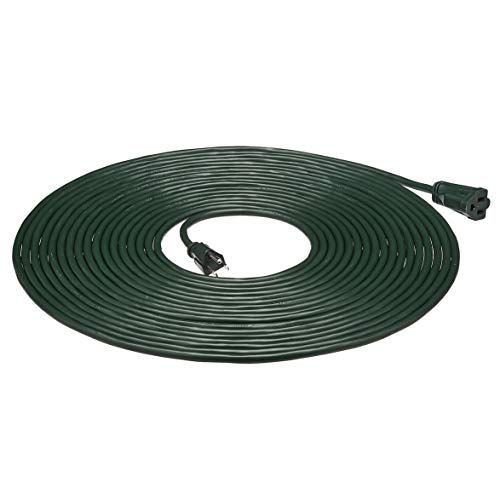
Amazon Basics 50-Foot 3-Prong Indoor/Outdoor Extension Cord
Fifty feet, green, 13 amps, indoor/outdoor rated. The listing does not state a wire gauge, so if you are running incandescent loads pick one that does.
$19.44
See it on Amazon
HUANCHAIN 16/3 Gauge Indoor Outdoor Green Extension Cord 50 ft Waterproof
16/3 is the right gauge for an all-LED display, and the listing states it plainly. Green vanishes against grass and beds better than orange ever will.
$28.99
See it on Amazon
K KASONIC Outdoor Extension Cord 50 FT, Evenly Spaced 6 Outlets, Green
The 50-foot, six-outlet version. One cord down the front of the house replaces the daisy-chain of four cords most DIY displays end up with.
$42.99
See it on Amazon
100ft Outdoor/Indoor Extension Cord 14/3 Gauge Heavy Duty 3 Prong SJTW…
Step up to 14 gauge when the run is long or anything on it is incandescent. SJTW jacket and cold-resistant, which is what the W in the rating is telling you.
$45.99
See it on Amazon
HUANCHAIN 14 Gauge Heavy Duty Outdoor Extension Cord 100 FT Waterproof
A hundred feet of 14 gauge for the far corner of the lot. Buy the length you need rather than coiling fifty feet of surplus by the outlet — a coiled cord under load is the one that gets warm.
$56.99
See it on Amazon
cismorvex 3 Pack Outdoor Extension Cord Safety Cover, Waterproof, Black
Three weatherproof connection covers for under ten dollars. There is no reason to have an uncovered joint outdoors at this price.
$9.99
See it on Amazon![[3 Pack] Flemoon Outdoor Extension Cord Safety Cover with Waterproof Seal](https://m.media-amazon.com/images/I/41hJ+ESBsXL._SL500_.jpg "[3 Pack] Flemoon Outdoor Extension Cord Safety Cover with Waterproof Seal")
[3 Pack] Flemoon Outdoor Extension Cord Safety Cover with Waterproof Seal
The single cheapest fix for nuisance GFCI trips. Water in a plug-to-plug joint on wet ground is the cause almost every time, and a sealed box removes it.
$18.99
See it on AmazonPrices checked Sep 24, 2026 and may change. As an Amazon Associate, Christmas Lights North Atlanta earns from qualifying purchases. We only list gear we would put on a customer's house; we buy our own commercial stock through distributors, not Amazon, so treat these as the closest equivalents a homeowner can actually order.
Power and timer questions
What gauge extension cord do I need for Christmas lights?
For an all-LED display, a 16 AWG outdoor cord handles a typical run. Step up to 14 AWG beyond about 50 feet or above 5 amps, and to 12 AWG beyond 100 feet or above 10 amps. Remember that AWG counts backwards - a smaller number is thicker wire. Any cord used outdoors must be outdoor-rated, indicated by a W in its jacket rating.
Why do my Christmas lights keep tripping the GFCI?
Almost always water sitting in a plug-to-plug connection on wet ground. Lift every joint off the ground and put it in a weatherproof connection cover and the problem usually disappears. If it still trips after that, something is genuinely faulty - a damaged cord or a failed string - and that is the safety device doing exactly its job. Do not solve a repeat trip by moving the display onto a non-GFCI outlet.
Timer or smart plug - which should I buy?
A photocell timer is cheaper and simpler: it senses dusk and runs for the hours you choose, with nothing to configure. A smart plug costs a little more and adds phone control, voice control, schedules and, on some models, dimming. For a single display a timer is plenty. Once the roofline, trees and yard are on different schedules, a smart plug earns its keep.
How much electricity does a Christmas light display use?
Very little with LEDs. A commercial LED C9 bulb draws about 0.96 watts against roughly 7 watts for the incandescent equivalent. A 300-bulb LED display running six hours a night for 45 nights costs a few dollars for the whole season at typical Georgia rates. The same display in incandescent bulbs would cost roughly ten times as much.
Can I run my whole display off one outlet?
Usually yes with LEDs, but check rather than assume. Keep any single 15-amp circuit under 1,440 watts - that is the 80 percent continuous-load limit - and remember the circuit may already be carrying something else. A large display with wrapped trees and lit shrubs can exceed it, and the answer then is to split across outlets on different breakers.
Do outdoor extension cords need to be plugged into a GFCI outlet?
Yes. Every outdoor circuit should be GFCI protected. Modern exterior outlets normally are, but older homes may not be, and a plug-in GFCI adapter is an inexpensive fix if yours is not. This is a safety requirement, not a nicety - it is what stops a fault in a wet cord becoming a shock.
We route power to code
Every install we do includes safe power routing, a timer or smart control set to your schedule, and full removal in January.