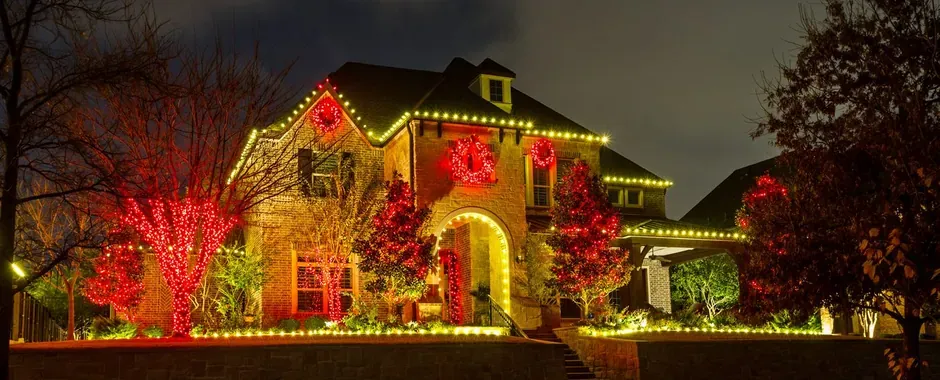
Ladder falls lead the holiday decorating injuries that emergency rooms treat, and the version we worry about most is January: a homeowner taking lights down in the cold, on a borrowed ladder, in a hurry. The install got all the planning in November. The removal got none.
That asymmetry is the honest starting point for a safety guide. Most Woodstock families do the decorating themselves, most of them are fine, and the ones who get hurt almost always get hurt on the parts nobody planned. What follows is what actually causes trouble and how to avoid it. Some of it applies to a homeowner on a ladder and some of it applies to hiring a crew, and both versions matter. If you decide the ladder is not for you, our Woodstock Christmas light installation page is where to get a free quote.
The checklist we wish every Woodstock DIYer kept on the fridge:
| Risk | The rule |
|---|---|
| Ladders | 4-to-1 angle, never the top two rungs, never alone |
| Power | Outdoor-rated GFCI circuits only, no indoor extension cords |
| Connections | Maximum three strings end-to-end on retail lights |
| Roof | If it is two stories or steep, it is a professional’s job |
| Pets and kids | Cords secured at the edges, timers instead of switches |
Ladders: the risk that dwarfs everything else
Nearly every serious holiday-lighting injury is a fall, and the pattern repeats.
The ladder gets set too steep or too shallow. The 4-to-1 rule fixes this: one foot out from the wall for every four feet of height. Set it right once and you stop thinking about it.
The last two rungs get used. They are not steps. If you need them, you need a taller ladder, which is cheaper than an ER visit.
Somebody reaches sideways instead of climbing down and moving the ladder. This is the single most common way a ladder goes over. Moving it six times is tedious. Falling once is not.
Nobody is holding the base. Working alone at height is the difference between a bad afternoon and a bad year.
Wet or icy footing turns any of the above into a fall. Cherokee County gets enough wet December mornings that this is a real variable, not a theoretical one.
Power, and what actually starts fires
Two failure modes cause most holiday electrical incidents, and both are avoidable.
Overloaded chains. Retail incandescent strings cap at three end-to-end for a reason, printed on the box. Past that, the first plug in the run carries current it was never rated for and heats up. LED strings tolerate longer runs because they draw far less, but the number on the packaging is a limit, not a target.
Indoor cords used outdoors. An indoor extension cord has thinner insulation and no weather sealing. Outside, in a Georgia December, it takes on water at the connection. Outdoor-rated cords on a GFCI-protected circuit are the whole fix, and GFCI is the part people skip because the outlet looks fine.
If your setup trips the GFCI repeatedly, that is the breaker doing its job and telling you something. Our GFCI troubleshooting guide explains what causes it and what to check. If half a string goes dark instead, the half-out diagnosis walks through finding the fault without guessing.
Connections belong off the ground, out of standing water, and pointed down so water runs away from the socket rather than into it.
Kids, pets, and a house full of people
A display that is electrically sound can still be a hazard at ground level.
- Route cords along the edges of walkways and driveways, then secure them. Loose cord across a path is the trip hazard that catches visitors in the dark.
- Keep plugs and connectors raised off the ground and dry. Puddles find connections.
- Use a timer instead of an accessible switch. It removes the nightly handling of a cold outdoor connector, and it means the lights work whether or not anyone remembers.
- Keep low strings and bulbs out of reach of a dog that chews. Shrub and pathway lighting is the usual culprit.
- Check that nothing blocks the front walk. December brings deliveries, visitors, and people walking backward taking photos.
The upside is real: a well-lit driveway and walkway makes the darkest weeks of the year safer for everyone who comes to your door, and pathway lighting keeps earning that after the season ends. It is one reason landscape and tree lighting often outlasts the roofline in a family’s priorities.
Where the DIY line actually sits
Plenty of Woodstock homes are perfectly reasonable to do yourself. A single-story ranch with an accessible roofline, a stable ladder position, and a homeowner who does not mind heights is a Saturday.
The line moves at two stories, and steep pitch moves it further. A tall gable over a garage looks simple from the ground and is genuinely dangerous from a ladder, because there is nowhere flat for the feet and nothing safe to lean into. That gable is the reason most families here eventually stop doing it themselves. Not the design. The height.
Our DIY versus professional comparison lays out the trade-offs honestly, and the DIY-or-pro tool asks four questions about your house and gives you a straight answer, including when the answer is that you do not need us.
What a professional install removes from your December: the ladder, the wiring, the load calculation, the mid-season repair, and the January takedown. Crews are fully insured, which matters because an uninsured helper falling on your property becomes your problem. Lights are commercial-grade LED, supplied and custom-cut, mounted with roof-safe clips rather than staples or screws, and the timer is set before the crew leaves. A section that goes dark in December gets fixed at no charge. Takedown happens in January and is included.
The takedown nobody plans
Removal is where people cut corners, and it is the step DIY households treat as an afterthought. It is the same ladder work as the install, in colder weather, at the least festive time of year, usually squeezed into a weekend somebody resents.
If you install your own, schedule the removal the same way you scheduled the install. Pick a dry day. Have a second person. Do not do it on the morning you decided the lights had been up too long. And take the clips off with the strings, because a clip left on a gutter through a Georgia summer becomes brittle and stops holding next year.
Or hand the whole cycle over, which is the quiet reason professional installation keeps growing in Woodstock. It is less about hanging the lights than about never being on the ladder at all.
The gear we would hand a Woodstock DIYer
If you are doing it yourself this year, buy to the standard the pros use. It is the difference between a display that lasts all season and a January headache. A few starting points from our gear guides:
- Commercial-grade LED light strings, with sealed bulbs and heavier wire that survive Georgia winters.
- Damage-free clips, stakes and gutter hooks, so there is never a nail or a staple in your roof.
- Outdoor timers, smart plugs and heavy-duty cords, which is safe power that runs the display for you.
Browse all of our recommended holiday lighting gear if you want the full list.
Safety questions Woodstock parents ask
What is the most common Christmas light injury?
A fall. Falls are the most common holiday decorating injury in U.S. Consumer Product Safety Commission data, and on a house that usually means a ladder. Homeowners plan the install carefully and then rush the takedown on a cold morning, often alone. If you do nothing else from this guide, schedule the removal the way you scheduled the install: a dry day, a second person on the ladder, and no deadline pressure pushing you to reach sideways.
How many light strings can I safely connect end to end?
Three is the standard maximum for retail incandescent strings, and the packaging will say so. LED strings often allow more because they draw far less current, but the number on the box is the number, not a suggestion. Chaining past it overheats the first plug in the run, which is one of the two most common causes of holiday decoration fires.
Are Christmas lights safe around kids and pets?
With a few habits, yes. Run cords along the edges of walkways and secure them so nothing becomes a trip hazard or a chew toy. Keep plugs and connectors off the ground and out of standing water. Use a timer rather than an accessible switch so nobody is unplugging and replugging a cold connector. Keep low strings out of reach of a curious dog.
When is a roof too high or too steep to do it yourself?
Two stories is the practical line, and steep pitch lowers it further. A tall gable over a garage looks simple from the driveway and is genuinely dangerous from a ladder because there is nowhere flat to set the feet and nothing safe to lean against. If you find yourself planning to reach sideways or stand above the third rung from the top, stop.
Does professional installation include taking the lights down?
Yes. January takedown is part of the season rather than a separate job, which matters because removal is the step homeowners most often do badly. The crew removes the strings and the clips so nothing is left on the roofline, and the bins go into labeled storage with us, so they never reach your garage unless you want them to.
More answers sit on our FAQ page. If you would rather skip the ladder entirely at your Woodstock home, send photos through the contact form or call or text (470) 777-7443, usually answered within one business day. Quotes are free, written, and itemized. Our residential installation service covers the whole season, and the main installation page explains what we supply across metro Atlanta.
Related articles
How Much Does Christmas Light Installation Cost in Atlanta? (2026)
Sep 2, 2026
Lease or Buy Your Christmas Lights? How the Two Models Work in North Atlanta
Sep 2, 2026
Planning Christmas Lights for an Alpharetta Home: HOA Rules, Rooflines, and Timing
Aug 15, 2026