HOA and community Christmas lighting across metro Atlanta
Entrance monuments, gatehouses, clubhouse rooflines, amenity buildings, and the mature trees every resident drives past twice a day. Christmas Lights North Atlanta has lit properties across metro Atlanta since 2018, with insured crews, commercial-grade LEDs supplied and cut on site, timers set before the crew leaves, in-season repairs at no charge, and January takedown under one seasonal agreement. Proposals are free, written, and itemized for a board vote.
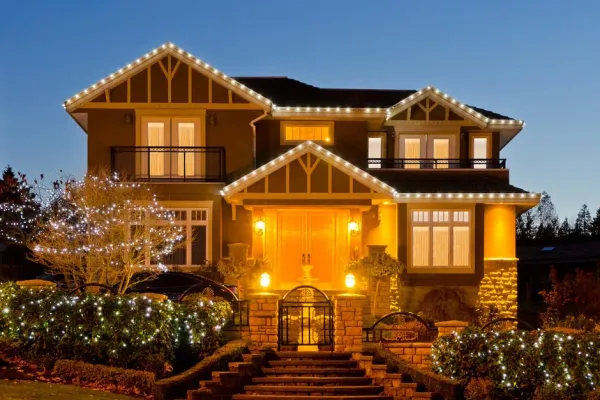
The display a whole neighborhood is judged by
The entrance is the one holiday display every resident sees, every single day, whether or not they decorate their own house. It is also the display nobody on the board wants to hang personally, which is how most communities end up here: a volunteer who used to handle it moved away, or the retail strings failed in the second week of December and the board inbox filled up.
We light the shared spaces. Entrance monuments and signage walls, gatehouses and guardhouses, clubhouse rooflines, pool and pavilion areas, and the hardwoods flanking an entry drive. Everything is commercial-grade LED cut to the measured footage of the structure, hung on roof-safe clips with no staples or screws, plugged into timers set before the crew leaves, repaired at no charge during the season, and taken down in January under the same agreement.
Boards work on a different clock than homeowners, and the process respects that. You get a written proposal itemized element by element, worded so it can be forwarded, questioned by email, and voted on without a follow-up call. Crews are fully insured for ladder and roof work, and certificates of insurance for the association or the management company go out with the proposal on request. Invoicing runs through the association or the property manager.
Christmas Lights North Atlanta is based in Cumming and works communities across metro Atlanta, from golf and gated neighborhoods around Alpharetta to master-planned developments and townhome associations near Lawrenceville and south of the city toward Peachtree City. Our city pages for Grayson, Holly Springs, Braselton, and Dacula go into the HOA neighborhoods on those routes. Proposals are free, written, and itemized. Call or text Christmas Lights North Atlanta at (470) 777-7443 or send photos of the entrance through the contact form to start, and book by November 1st for the 10% early-bird discount and first pick of install dates.
Proposals written for a board vote
Every element priced on its own line: monument wall, columns, the two oaks at the drive, clubhouse roofline, entry canopy. A description residents can picture, photos of comparable work, and the insurance documentation your property manager will ask for anyway. Built to be forwarded and discussed rather than explained on a call.
Insured crews on common property
Crews are fully insured for ladder and roof work, which is exactly the exposure an association should not be carrying on a volunteer Saturday. Certificates naming the association or management company are provided on request before anyone sets foot on community property.
Repaired fast, all season
A dark section on a private home disappoints one family. A dark entrance monument reaches the whole board by Sunday night. In-season service calls are at no charge and community sites get priority, with crews carrying spare bulbs, cord, clips, and timers so most fixes happen in a single visit.
One agreement, no resident ladders
Design, product, install, timers, in-season repairs, and January takedown sit under one seasonal agreement, with labeled storage between seasons. The board approves once and the neighborhood gets a finished entrance, on schedule, without anyone's weekend.
What gets lit in a community
Entrance monuments come first because they are the highest-visibility square footage a neighborhood owns. A typical monument takes C9s outlining the sign wall or cap, lit garland across the face, wrapped columns or pilasters, and minis through the surrounding beds. Stone and brick monuments are worked with tension clips, stakes, and greenery ties rather than anything driven into masonry.
Gatehouses and guardhouses take rooflines and window trim, which reads well because they are small structures at close range. Clubhouses are treated like the commercial buildings they are: C9 runs along gutter edges and gables, oversized wreaths sized to the entry rather than to a front door, and lit canopies over the drop-off. Pools and pavilions usually take a lighter touch, warm minis on the structure and the nearest trees.
Then the trees. Mature oaks and maples flanking an entry drive, wrapped at the trunk and out along the first main limbs, do more for a community's December presence than any other single element. Spacing is set from trunk circumference, and terminations are kept low and dry. The tree wrapping page covers the technique in detail.

Power and timers at an entrance
Common areas are where power planning matters most, because entrances are rarely built with holiday lighting in mind. Many monuments have a single landscape-lighting circuit and one outlet inside a pedestal or an irrigation box, so the site walk includes finding it, testing it, and confirming it is GFCI protected. Where a circuit will not carry the whole design, the plan splits feeds or the scope moves to what the available power supports rather than tripping a breaker on the first cold night.
Long entry drives introduce the other problem. LED draw is low, but a very long chain still dims at the far end, so runs down a drive are split into separate feeds rather than daisy-chained from one end. Cord is rated for outdoor use, tucked along bed edges or under mulch, and kept out of the path of mowers and string trimmers.
Timers get set before the crew leaves, and photocell timers suit common areas because nobody lives there to adjust anything. Most boards choose dusk to midnight, sometimes later for the two weeks around Christmas. If the association wants the entrance lit for a specific event evening, tell the crew on install day and the schedule gets set then.
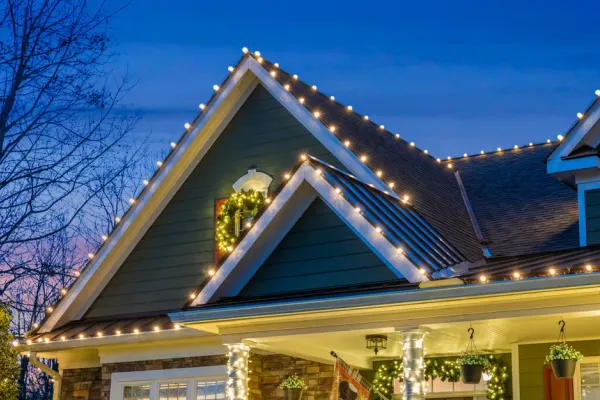
Why communities outgrow volunteer lighting
Most HOA lighting starts as a volunteer project: a few residents, a Saturday morning, strings from a big-box store. It works until it does not. The volunteer moves, the retail strings quit in week two because their sockets are molded shut and one failure darkens the whole strand, and someone on the board eventually asks whether the association's coverage was ever meant to include a resident on a ladder above the entrance sign.
Liability is the quiet reason boards professionalize this. Our crews are insured for exactly this work, at height, on community property, and the association carries neither the risk nor the labor.
Consistency is the loud reason. A professional display looks the same in year four as it did in year one, goes up on a scheduled date, and gets repaired within a day or two when Georgia weather takes a swing at it. Product is the other half of that: commercial-grade C9 cord with individually replaceable screw-in bulbs, cut to the measured footage of your structures, so one bad bulb is a two-minute fix instead of a dark monument.
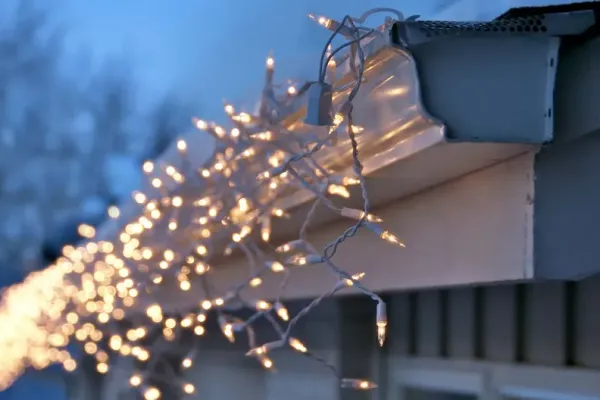
Communities and commercial sites across metro Atlanta
We install for communities throughout metro Atlanta, from the north suburbs where the company started to in-town associations, out through Cobb and Gwinnett, and south and west of the perimeter. Crews route in geographic clusters through install season, and community work is scheduled early in the window because entrances and clubhouses take longer than a single-family roofline.
Community stock varies as much as housing stock does. Gated golf neighborhoods have monuments, gatehouses, and clubhouses to coordinate. Master-planned developments along the growth corridors have several entrances that need to match each other. Townhome and condo associations often have one small monument and a mailbox kiosk, which is a short, inexpensive scope to keep looking sharp year after year. That is why every proposal comes from a site walk rather than a chart.
Mixed-use and retail property in a community, such as an amenity building leased to a tenant or a small commercial strip at the neighborhood entrance, is quoted the same way and covered on our commercial lighting page. If your community sits just outside the areas we name, ask anyway; common-area work routes efficiently and we take it on when the calendar allows.
Questions HOA boards and property managers ask
The practical details, before the proposal stage.
How is community lighting quoted?
Per project, from a site walk, because scope varies enormously. One monument with two wrapped trees is a different job than a clubhouse roofline plus a quarter mile of entry drive. We measure the structures, size the trees, note power and access, then write a free proposal itemized element by element so the board can keep or cut any single line without redrawing the plan.
What does the board approval process look like?
A board member or the property manager walks the site with us. Within a few days you have a written itemized proposal with photos and insurance documentation attached. Boards circulate it, ask questions by email, and vote on their own cycle. We hold the quoted pricing while you deliberate, and the community goes on the install calendar as soon as we have written approval.
Can you provide a certificate of insurance for our management company?
Yes. Our crews are fully insured for ladder and roof work, and certificates naming the association or the management company are standard paperwork. They go out with the proposal or before installation, depending on which your process requires. Ask at the site walk and we will have the documentation ready before the board even votes.
When should our board start this conversation?
Early fall at the latest, and summer is better if the spend needs to land in a budget cycle. Most boards need a meeting to approve it, and install dates go to the projects approved first. Communities that sign by November 1st get the early-bird discount and first pick of pre-Thanksgiving dates, which is when residents expect the entrance to be lit.
Do you handle multi-year agreements?
Yes, and most communities move to one after the first season. A multi-year agreement locks the design, keeps the install window on the calendar, and means the entrance simply gets lit each year without a new round of proposals and votes. We store the community's display between seasons unless the board prefers otherwise, which pairs naturally with a repeat agreement.
Can residents book their own homes at the same time?
Yes, and it makes scheduling easier for everyone. When a community books its common areas with us, we coordinate resident installs into the same routing days so crews are already in the neighborhood. Each resident still gets their own free written quote, measured from their own roofline, trees, and design density.
Put a proposal in front of your board
Free site walk, free written proposal itemized element by element, certificates of insurance included. Call or text (470) 777-7443, or send photos of your entrance through the contact form. One agreement covers design, install, timers, in-season repairs, and January takedown. Communities approving by November 1st get the 10% early-bird discount and first choice of install dates.
Get a free quote for your house
Text us a photo of the front of the house and your address, call, or fill out the form. You get a written, itemized quote, usually within one business day.