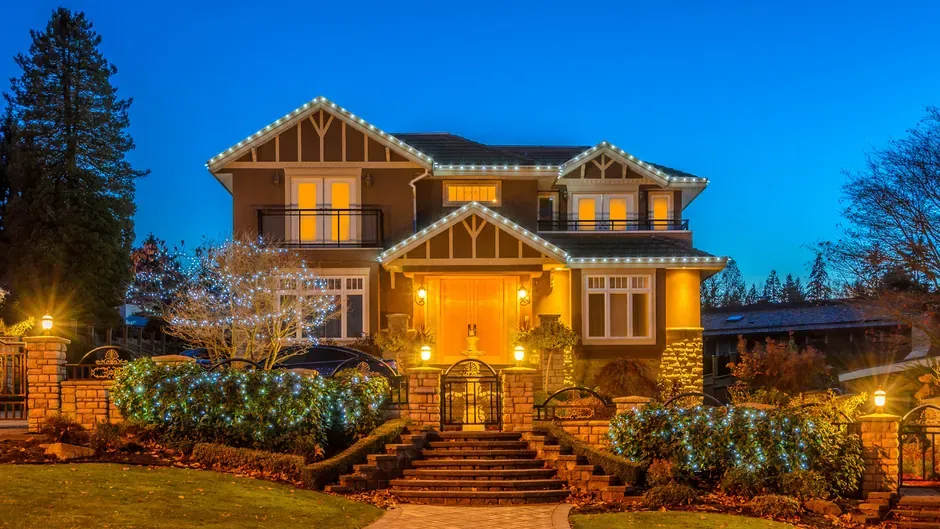
Light a 150-foot roofline for the season and the electricity bill splits like this: about $29 to $33 with C9 incandescent bulbs, about $4 to $5 with C9 LEDs. Same house, same six weeks, same five hours a night. The only change is the bulb. LEDs draw roughly a tenth of the power, and at Georgia Power residential rates of about 13 to 15 cents per kilowatt-hour, that gap is the whole story on the utility bill.
A $25 to $28 saving will not change anyone’s December. The honest case for LED sits behind the power math: bulbs rated for 25,000 to 50,000 hours instead of 1,000 to 2,000, almost no heat, and an electrical load so light that one exterior outlet can carry a display that would trip breakers on incandescent. Every assumption below is shown inline, so you can rerun the numbers for your own roofline.
How much power do C9 Christmas lights actually draw?
C9 is the classic big bulb you picture on a Georgia roofline, and the two versions of it are not close. A traditional incandescent C9 draws about 7 watts. Retail versions range from 5 to 10 watts, so 7 is a fair middle. An LED C9 draws about 1 watt, and many commercial-grade bulbs come in near half that. We will use 1 watt to keep the comparison conservative.
Spacing sets the count. At the standard 12-inch spacing, a 150-foot roofline carries 150 bulbs. The incandescent version of that roofline pulls 150 bulbs times 7 watts, which is 1,050 watts, slightly more than a running microwave, mounted along your gutter line. The LED version pulls 150 watts, about what a pair of ceiling fans uses.
Mini lights follow the same direction with a narrower gap. A 100-count incandescent mini string draws about 40 watts, while a 100-count LED string draws 5 to 8. Rooflines around metro Atlanta mostly get C9s, though. Minis show up in tree wraps and shrubs, where the bulb counts climb fast enough that the gap widens again in absolute terms.
The season math on a 150-foot Georgia roofline
Now the hours. Assume the display runs 5 hours a night, dusk until a 10 or 11 pm timer cutoff, for six weeks from Thanksgiving into early January. That is 42 nights times 5 hours, or 210 hours for the season. Priced at Georgia Power residential rates, which land around 13 to 15 cents per kilowatt-hour once fuel costs and riders are included, the season looks like this:
| Assumption | C9 incandescent | C9 LED |
|---|---|---|
| Bulbs on 150 feet at 12-inch spacing | 150 | 150 |
| Draw per bulb | 7 watts | 1 watt |
| Total load | 1,050 watts | 150 watts |
| Season hours, 5 per night for 42 nights | 210 | 210 |
| Season energy | about 220 kWh | about 32 kWh |
| Season cost at 13 to 15 cents per kWh | $29 to $33 | $4 to $5 |
Change the assumptions and the numbers move in a straight line. Run 7 hours a night and both columns grow 40%. Leave the display up into mid-January, same effect. Use half-watt LED bulbs, common in commercial-grade product, and the LED column drops near $2. At our conservative 1-watt figure, incandescent costs seven times more to run; with the half-watt bulbs professional installers actually hang, the multiple passes ten.
What happens to the bill when the display grows?
Electricity is the small cost. Capacity is where incandescent actually bites. A standard 15-amp exterior circuit supplies 1,800 watts, and the safe continuous load is about 80% of that, or 1,440 watts. Our sample incandescent roofline already claims 1,050 of it. Add a wrapped tree, some garland, a few lit wreaths, and you are soon running cords through a window to a second circuit, which is how December breaker trips and overheated extension cords tend to start.
The same growth in LED barely registers. A 400-foot display, more than double the sample, pulls about 400 watts and costs $11 to $13 for the season at the same rates. On incandescent, that display pulls 2,800 watts, needs two dedicated circuits, and runs $76 to $88 in power. Once a design includes tree wraps, which concentrate hundreds of bulbs in one spot, incandescent stops being realistic on most homes’ wiring. That is one reason every install we do is LED.
Tree wraps show the spread in miniature, and wrapping a trunk and canopy puts hundreds of bulbs in a single spot. A single maple wrapped with 600 incandescent minis adds about 240 watts, which works out to roughly 50 kWh and $7 over the season. The LED version of the same wrap adds about 40 watts and costs under a dollar and a half.
How many seasons do LED Christmas lights really last?
LED diodes are rated for 25,000 to 50,000 hours. At 210 hours a season, the diode rating is effectively unlimited, over a century on paper. What actually ends a light string is everything around the diode: the wire jacket, the socket seals, the connections, all of it living outdoors through Georgia rain and then a hot attic all summer, which is part of why labeled off-season storage exists. In practice, commercial-grade LED strings run 15 to 20 seasons before weathering retires them.
Incandescent filaments are rated for 1,000 to 2,000 hours, which covers one or two seasons of heavy use before bulbs start failing in numbers, on top of the glass that breaks during install and takedown. Retail incandescent strings tend to get replaced within 1 to 3 seasons. Price that over 15 years: roughly five rounds of replacement strings against a single LED purchase, and the box-price advantage incandescent starts with is gone well before the halfway mark. Warranties tell the same story in fine print. Commercial-grade LED product commonly carries multi-season coverage, while a retail box is often warranted for 90 days.
Heat is a cost too
Run 1,050 watts through filaments and nearly all of it becomes heat. That is a space heater’s output distributed along your roofline, which is why incandescent C9s are uncomfortable to handle after an evening on, and why they have scorched vinyl trim and dried-out garland in plenty of homes. LEDs stay cool to the touch at any hour of the night.
Heat also ages the product itself. Insulation goes brittle, sockets brown, filaments fatigue. Georgia adds its own twist, since our Decembers are wet more often than they are cold, and warm rain finding hot sockets is a harder test than dry northern snow. And because incandescent circuits run close to capacity, blown fuses become a December tradition of their own. To be fair, incandescent bulbs lit American houses for decades and mostly behaved. But for a display that runs on a timer while the family sleeps, cool bulbs pulling a tenth of the load are the better unattended default.
Do LEDs still look worse than incandescents?
This objection was earned. Early LED strings looked blue, flickered on camera, and dimmed unevenly along a run. Most of that is obsolete. Warm white LEDs at 2700 Kelvin now sit close enough to incandescent glow that the difference is hard to call from the street, and commercial-grade strings use full-wave rectification, which removes the flicker cheap bulbs still show.
Consistency actually flips in LED’s favor over time. Incandescent bulbs dim as filaments age, and painted colors fade, so a three-year-old display glows unevenly. LEDs hold brightness and color across the string and across seasons. If you are buying your own, four lines on the box are worth checking:
- Full-wave rectified, which is what kills the flicker.
- Warm white around 2700K, unless you genuinely want the cooler look.
- Gasketed sockets rather than press-fit ones, since water is what ends most strings.
- Replaceable bulbs, so one dead diode does not retire a whole run.
If we install, that is simply what goes up. Our LED installation service hangs commercial-grade LED product on every job, in warm white, multicolor, or both.
Which one wins on total cost of ownership?
Add it up for the 150-foot roofline over a decade. Incandescent means a cheaper box, $29 to $33 of power every season, replacement strings every couple of seasons, and a hard ceiling on how large the display can grow. LED means two to three times the upfront box price, $4 to $5 of power, and product that outlasts the comparison window. For a self-installed display, the crossover typically lands inside two seasons. For a professionally installed one, there is no crossover to wait for, because packages like ours are quoted with commercial LED product already in the price. What moves that quote is roofline footage, height, trees, and design density, all of it broken down in our cost guide and on the installation cost page.
We have installed LED exclusively across 7,500+ homes since 2018, so the operating numbers above are the ones our customers actually see on their bills. To price your own roofline instead of a sample one, send a photo of the front of the house through the contact form or call (470) 777-7443 for a free itemized quote covering product, insured installation, maintenance, and January takedown. Installs run late October to mid-December. Book before November 1st and the early-bird discount takes 10% off. The FAQ covers scheduling, service calls, and what happens in bad weather.
LED and incandescent questions we hear most
How much does it cost to run Christmas lights in Georgia?
On a 150-foot roofline running five hours a night for six weeks, C9 incandescent bulbs use about 220 kWh, which is roughly $29 to $33 at Georgia Power residential rates of 13 to 15 cents per kilowatt-hour. The same roofline in C9 LED uses about 32 kWh, or $4 to $5 for the whole season.
Do LED Christmas lights look as warm as incandescent?
Modern ones do. Warm white LEDs at 2700 Kelvin sit close enough to incandescent glow that the difference is hard to call from the street, and commercial-grade strings use full-wave rectification, which removes the flicker cheap bulbs still show on camera. The blue, uneven strings that earned this objection are two product generations old.
How many light strings can one outdoor outlet handle?
A 15-amp exterior circuit supplies 1,800 watts, and the safe continuous load is about 80% of that, or 1,440 watts. A 150-foot incandescent C9 roofline already claims 1,050 of it, so tree wraps and garland push you onto a second circuit fast. The same display in LED draws about 150 watts and leaves room to grow.
How long do LED Christmas lights last outdoors?
The diodes are rated for 25,000 to 50,000 hours, which at roughly 210 hours a season is effectively unlimited. What retires a string is the wire jacket, the socket seals, and the connections weathering Georgia rain and summer heat. Commercial-grade LED strings usually run 15 to 20 seasons; retail incandescent tends to get replaced within one to three.
Are LED lights safer than incandescent on a roofline?
They run cooler, which matters. Nearly all of the 1,050 watts an incandescent roofline draws leaves as heat, enough to scorch vinyl trim and dry out garland, and hot sockets meeting warm December rain is a harder test than dry snow. LEDs stay cool to the touch and pull about a tenth of the load.
Related articles
How Much Does Christmas Light Installation Cost in Atlanta? (2026)
Sep 2, 2026
Lease or Buy Your Christmas Lights? How the Two Models Work in North Atlanta
Sep 2, 2026
Planning Christmas Lights for an Alpharetta Home: HOA Rules, Rooflines, and Timing
Aug 15, 2026