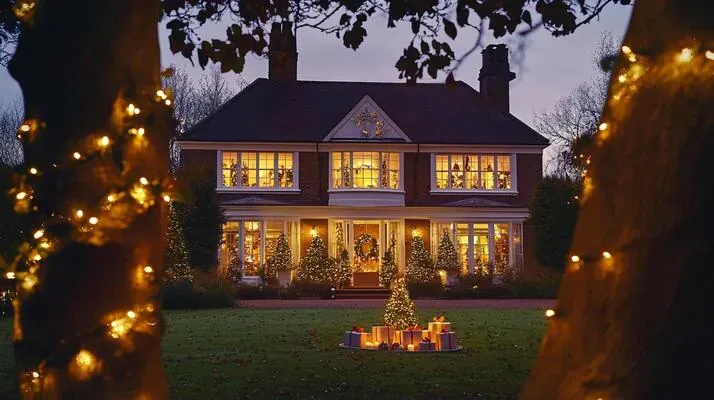
What a professional Christmas light display costs in metro Atlanta depends on four things you can measure at your own house: the linear feet of roofline you want lit, how high that roofline sits, how many trees and shrubs get wrapped, and how dense the design is, plus any specialty pieces like columns or wreaths on top. Installers price all of it in roughly the same way, and once you see how, a quote turns into a list of decisions you control. A firm quote for your house takes one call or a couple of photos and usually comes back within one business day.
Here are the factors on one table, with a way to check each from your own driveway.
| Factor | What it changes | How to check it at your house |
|---|---|---|
| Roofline footage | The base of the quote, since lighting is priced by the linear foot | Pace the roof edges you want lit from the ground; a normal stride is close to three feet |
| Home height | Ladder time, rigging, and crew size on tall peaks | Count stories, and note any foyer peak or gable that stands taller than the rest |
| Trees and shrubs | Product and labor for each wrap; a trunk takes more light than it looks | Count every tree and shrub you want lit, and note the big trunks |
| Design density | Product close to doubles when gutter edge and peak are both outlined | Decide between a single run along the gutters or gutters plus peaks |
| Specialty elements | One added line each: columns, dormers, wreaths, pathways | List anything you want lit beyond the roofline and the trees |
What determines the price of a Christmas light install
Roofline footage is the biggest driver, and it is the one that explains why two houses on the same street in Alpharetta can quote far apart. Lighting is priced by the linear foot, so a wraparound roofline with three gables has more edge to light than a plain rectangle, and that edge is what you are paying for.
Home height is next. A one-story ranch in Kennesaw is a ladder job from the lawn. A two-story colonial takes taller ladders, more repositioning, and more care around the eaves. A three-story foyer peak over a Johns Creek entryway needs rigging that a ranch never does, and that time is in the quote. Access matters as much as height: a steep pitch, a roofline over a sunroom, or a peak that can only be reached from the roof itself all slow a crew down.
Trees and shrubs surprise people. A wrapped trunk takes far more light than it looks like it should, because the strand has to spiral the whole trunk from the ground up to the first branches, and then the canopy on top of that. Two big maples flanking a driveway in Roswell can carry as much product as a short roofline. Shrubs and hedges are lighter work, but every one is counted.
Design density is the quiet one. A roofline outlined on both the gutter edge and the peak uses close to twice the product of a single clean run along the gutters, so the same house can price two different ways depending on how full you want the look. Specialty elements sit on top of all of it: wrapped columns at the entry, dormers outlined on their own, a lit path to the front door, wreaths at the windows. Each is its own line, which is what lets you keep or cut it.
How per-foot pricing works
Installers price the roofline by the linear foot. The measured footage times a per-foot rate is the base of the quote. Height factors get applied to that base for two-story and three-story work, tree wraps are priced per tree by size, and landscape or pathway runs are measured and priced on their own footage. A longer or taller roofline costs more for the same reason a longer fence does: more material, more hours, more of the crew’s day.
What the per-foot rate buys is where companies differ, and it is the part to ask about. For some installers the rate covers labor only, and you buy the lights. For a full-service package it covers the lights themselves, the install, the season’s maintenance, and the takedown, which is why an all-inclusive per-foot rate will read higher than a labor-only one. Comparing two per-foot rates without knowing what is inside each one tells you nothing.
The footage is not negotiable, but which footage gets lit is, and that lever comes up again below.
What a full-service package includes
Our all-inclusive package is built so that the number on the quote is the number on the invoice. Inside it:
- Commercial-grade LED lights, supplied by us and chosen for the design
- A layout worked out from your photos or a visit, itemized before anything is hung
- Roof-safe installation on clips that grip the shingle edge and gutter, never staples or screws
- Timers set before the crew leaves, so the display runs on its own schedule from the first night
- In-season service calls at no charge if a section goes dark
- Takedown in January, including the clips and timers
- Labeled off-season storage with us, so next season starts with a phone call
What is usually not included: a new exterior outlet. If the house has no power where the display needs it, an electrician installs one, and it is priced separately from the lights. On install-only work, replacing your own product when it fails is on you. We still store it between seasons unless you would rather keep it, and if you do, a garage shelf or a basement corner beats a hot attic, which is hard on wire insulation and socket seals.
Lease versus buy
Two ways to buy the same display. All-inclusive means we supply the lights and everything that follows, and the product never becomes yours to store or repair. Install-only means you own commercial-grade lights, we hang them, and the rate is lower because no product is on the ticket. Which one comes out ahead depends on how many seasons you keep the same design on the same house, and on having somewhere cool and dry to keep several bins of strands through a Georgia summer. Most first-year customers choose all-inclusive and revisit the question once they know what they like. The full comparison is in our lease versus buy guide.
How to read and compare quotes
A trustworthy quote is itemized and locked: roofline footage on one line, each tree on its own, every specialty element listed, and a total that does not move after the work is done. A single round number with no breakdown is a reason to ask more questions. Three of them explain most of the difference between any two quotes you will collect in metro Atlanta.
Ask whether maintenance is included. If a section goes dark in December, a fix from the installer’s stock at no charge and a fix billed per visit are very different things by New Year’s.
Ask whether takedown is included. Some quotes end at the install and bill removal in January as a separate ticket.
Ask who owns the lights. A quote where the installer supplies and stores the product is priced with the product inside it. A quote on lights you buy yourself is not. Put an all-inclusive quote next to another all-inclusive quote, or install-only next to install-only, and most of the gap closes on its own. What is left over is usually crew size, whether the crew is insured, and the grade of light going on the roof. All three are fair questions.
Honest ways to bring the number down
None of these cut corners. They cut footage or timing, which is where the number lives, and our roofline planner turns a quick pace-off into a footage figure if you want to see the effect before you call.
- Light the street-facing rooflines and skip the back of the house that only the yard sees. The display reads the same from the road.
- Choose a single clean run along the gutters instead of outlining the peaks as well. It is the crispest look on most houses and uses close to half the product.
- Wrap the two trees that frame the front, not every tree on the lot.
- Book before November 1st. The early-bird discount takes 10% off any package, and it comes with first pick of install dates.
The DIY alternative, honestly
You can hang your own lights, and plenty of people in metro Atlanta do. The honest comparison is about what you are buying with the money you save. Retail strings from a big-box store fail far more often than commercial product, and they tend to fail in the middle of December, which means a second climb in the cold to find the dead section. A second-story eave sits about 22 feet up, and a ladder at that height on a sloped lawn in wet leaves is the part of the job people get wrong, not the clips. Add the Saturday it takes to hang everything, and the January trip to get it all back down and into bins.
Professional installation costs more than a cart of store lights. What it removes is every item on that list, with an insured crew on the ladder instead of you and a service call instead of a hunt for the failed bulb. Our DIY versus professional comparison runs the full breakdown.
When to book
Installs run from late October to mid-December across North Atlanta, and the calendar does not fill evenly. November weekends fill fastest, and the late-November window is gone first almost every year, with whatever December dates remain depending on weather. Book by November 1st and two things happen: the 10% early-bird discount comes off the quote, and you get first pick of dates instead of the leftovers.
How to get your quote
Call or text (470) 777-7443, Monday through Saturday from 8 AM to 7 PM, or send a photo of the front of your house through the contact form. A straight-on shot from across the street that shows the whole roofline and the trees in front of it is enough to start; a slow phone pan along the roofline helps on taller or more complicated houses. A written, itemized quote usually comes back within one business day, and if a visit makes more sense, we schedule one, still free.
Nothing is owed until the display is installed and tested. The installation cost page walks through what goes into the number step by step, and the FAQ covers scheduling, safety, and weather.
Common questions about Christmas light installation cost
What is the biggest factor in a Christmas light installation quote?
Measured roofline footage. Lighting is priced by the linear foot, so the edge you want lit sets the base of the quote before anything else is added. Home height comes next, because a three-story foyer peak takes rigging a ranch never needs. Trees, design density, and specialty pieces like columns or wreaths each add their own line.
Does the quote include the lights themselves?
On an all-inclusive package, yes. We supply commercial-grade LED product cut for your design, install it, maintain it through the season, take it down in January, and store it if you want. On install-only work you own the lights and the rate is lower, because no product sits on the ticket. Ask any installer which one their rate covers.
Can the price change after the work is done?
Not on our quotes. The written estimate is itemized before anything is hung: roofline footage on one line, each tree on its own, every specialty element listed, and a total that holds. A single round number with no breakdown is worth questioning, since it leaves room for the figure to move once the ladders are on your lawn.
How do I get a quote without scheduling a visit?
Send a straight-on photo of the front of the house from across the street, showing the whole roofline and the trees in front of it. Text it or use the contact form. A slow phone pan along the roofline helps on taller houses. A written, itemized quote usually comes back within one business day, and a site visit is free if one makes more sense.
Is January takedown billed separately?
Not on our packages. Takedown is included, along with removal of the clips and timers, and the lights go into labeled off-season storage with us unless you would rather keep them. Some quotes in metro Atlanta end at the install and bill removal as its own January ticket, so it is worth asking before you compare two totals.
Related articles
Lease or Buy Your Christmas Lights? How the Two Models Work in North Atlanta
Sep 2, 2026
Planning Christmas Lights for an Alpharetta Home: HOA Rules, Rooflines, and Timing
Aug 15, 2026
Estate Christmas Light Design in Johns Creek: Layers, Scale, and Community Rules
Aug 15, 2026