Christmas Lights Tripping the GFCI: Causes and How to Fix It
The outlet clicks off within minutes of switching the display on, and resetting it only buys you a few hours.
The short answer
Nine times out of ten it is water in a plug-to-plug connection lying on wet ground. Lift every joint off the ground, put it inside a weatherproof cover, and the tripping usually stops for the season. If it still trips with every connection dry and covered, something is genuinely faulty - and that is the GFCI doing its job, not a nuisance to be worked around.
What is actually causing it
In the order we find them, most common first.
-
1.Water in a plug-to-plug connection on the ground
Free to fix most commonHow to check: Walk the run and find every place two plugs join. Any of them lying in grass, mulch or a puddle is a suspect - and they will all be damp, because that is where water collects.
The fix: Lift each joint off the ground onto a stake, a brick, anything, and wrap or cover it. This alone resolves most cases and costs nothing to try right now.
-
2.Water inside the light strings themselves
Free to fix commonHow to check: Unplug everything, then plug in one string at a time and wait a couple of minutes before adding the next. The string that trips it is the faulty one.
The fix: A string with water inside the wire or a cracked bulb socket is done. Retire it - and if it was a cheap retail string in its second season, that is the ordinary end of its life rather than bad luck.
-
3.Too much load on one circuit
Free to fix less commonHow to check: Add up the wattage of everything on that outlet, including anything already plugged in indoors on the same breaker. Keep a 15-amp circuit under 1,440 watts.
The fix: Split the display across outlets on different breakers. Note that a genuine overload usually trips the BREAKER rather than the GFCI - if the little button on the outlet is what pops, look for moisture first.
-
4.An indoor-rated cord being used outside
less commonHow to check: Check the jacket for a W in the rating. No W means it is not rated for outdoor use.
The fix: Replace it with an outdoor-rated cord. Indoor cords absorb water through the jacket and will keep tripping the GFCI no matter how well you cover the ends.
-
5.A faulty GFCI outlet
rareHow to check: Unplug everything from it. If it still will not hold a reset with nothing connected, the outlet itself has failed.
The fix: GFCI receptacles wear out, typically after ten to fifteen years. Replacing one is an electrician job unless you are confident and the power is off at the breaker.
Finding the fault, in order
- 1
Unplug everything and reset the outlet
Pull every plug out of the outlet and press reset. If it will not hold a reset with nothing connected, the outlet has failed and the lights are not your problem.
- 2
Add one string at a time
Plug in a single string and wait two or three minutes. Water faults are often not instant. Add the next only once the current one has held. When it trips, the last thing you added is the fault.
- 3
Inspect every connection on that section
Look for joints resting on ground, in mulch, or in standing water, and for any plug that looks corroded or discolored inside. Damp is enough - it does not have to be submerged.
- 4
Lift and seal every joint
Raise each connection off the ground and enclose it in a weatherproof cover. Where a cover will not fit, self-fusing silicone tape seals the joint without leaving adhesive behind.
- 5
Reset and watch it through one full night
Most water faults show themselves within a couple of hours, and especially after dew forms. If it survives a full night including the small hours, it is fixed.
There is one call we get more than any other in a wet December, and it is always some version of this: the lights worked fine for a week, now the outlet clicks off every evening.
The reason it is so consistently the same fault is that outdoor displays are full of plug-to-plug joints, those joints end up on the ground because that is where gravity puts them, and the ground in a Georgia December is wet more often than it is dry. Water bridges the contacts, a small current leaks to earth, and the GFCI does exactly what it was installed to do.
Why this is good news
A GFCI trip is not a fault in your lights so much as a report about them. The device is telling you there is a leakage path to ground somewhere in the run, and it is telling you before anyone touches it in the rain. That is the entire point of the thing.
Which is why the one response you should never have is to move the display onto an outlet without protection. It does not fix anything; it just removes the part that was watching.
The habit that prevents it entirely
When we install a display, no connection is left on the ground anywhere. Every plug-to-plug joint gets lifted and covered, as standard, on every job, not because we are especially cautious but because doing anything else generates a callback in the first wet week.
It is a five-minute habit at install time that removes most of a season’s problems, and it is the single most useful thing on this page.
As an Amazon Associate, Christmas Lights North Atlanta earns from qualifying purchases. We list these because they fix the problem above; where the fix is free, we have said so.
Seal the connections (this is the actual fix)
Once every plug-to-plug joint is off the ground and inside a weatherproof cover, this problem usually disappears for the season. It is the cheapest repair on this whole site.

cismorvex 3 Pack Outdoor Extension Cord Safety Cover, Waterproof, Black
Three weatherproof connection covers for under ten dollars. There is no reason to have an uncovered joint outdoors at this price.
$9.99
See it on Amazon![[3 Pack] Flemoon Outdoor Extension Cord Safety Cover with Waterproof Seal](https://m.media-amazon.com/images/I/41hJ+ESBsXL._SL500_.jpg "[3 Pack] Flemoon Outdoor Extension Cord Safety Cover with Waterproof Seal")
[3 Pack] Flemoon Outdoor Extension Cord Safety Cover with Waterproof Seal
The single cheapest fix for nuisance GFCI trips. Water in a plug-to-plug joint on wet ground is the cause almost every time, and a sealed box removes it.
$18.99
See it on AmazonIf it still trips, find out where
An outlet tester tells you in one second whether the fault is your lights or the outlet they are plugged into. Roughly half the calls we get about tripping breakers turn out to be the outlet.
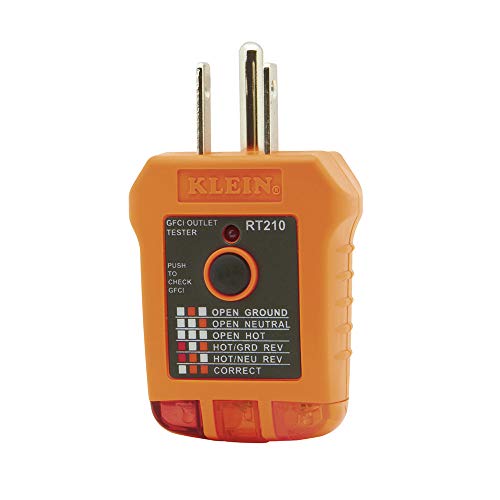
Klein Tools RT210 Outlet Tester
Plugs into the outlet and tells you in one second whether the fault is your lights or the socket they are in. Half the 'my lights are broken' calls we get are an outlet with a tripped GFCI or a wiring fault.
$13.98
See it on AmazonIf your outdoor outlet has no GFCI at all
Common on older homes around Atlanta. A plug-in GFCI adds the protection at the plug. This is a safety device, not an upgrade. Do not run outdoor lights without one.
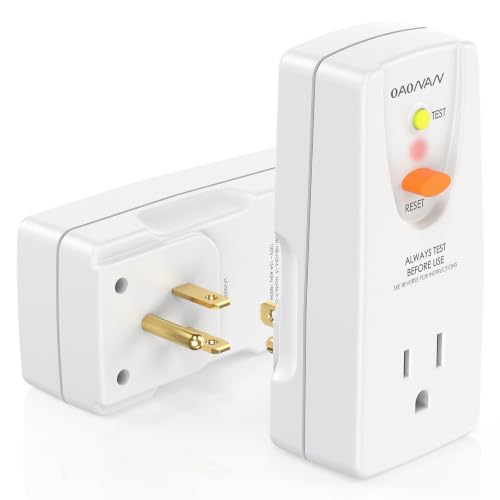
OAONAN GFCI Adapter 15 Amp 3 Prongs Grounded, 5 Years Warranty
If your outdoor outlet is not GFCI protected - common on older North Atlanta homes - this adds that protection at the plug. It is a safety device, not a convenience, and it costs less than one string of lights.
$16.99
See it on AmazonPrices checked Sep 24, 2026 and may change.
Related questions
Can I just plug the lights into a non-GFCI outlet instead?
No. A GFCI that keeps tripping is detecting current leaking somewhere it should not - which outdoors, on wet ground, is exactly the fault that can shock someone. Moving the display to an unprotected outlet does not fix the leak, it removes the thing that was protecting you from it. If anything, an older home without GFCI protection outdoors should have a plug-in GFCI added.
Why do my lights only trip the GFCI when it rains?
Because the fault is water, and you have just confirmed it. Rain and heavy dew get into plug joints and cracked sockets, current leaks to ground, and the GFCI does what it exists to do. Fix the joints rather than waiting for dry weather - the same fault will come back with the next front.
What is the difference between the GFCI tripping and the breaker tripping?
The GFCI is the outlet with the little test and reset buttons, and it trips when current is leaking to ground - almost always moisture. The breaker is in your panel and trips when the circuit is drawing more current than it is rated for - an overload. Which one popped tells you which problem you have, so check before you start.
How many LED Christmas lights can I run on one circuit?
A lot. Commercial LED C9 bulbs draw about 0.96 watts each, so a 15-amp circuit at its 1,440-watt continuous limit would take well over a thousand of them in theory. In practice you are limited first by the maximum connected sets printed on the box, and by whatever else is already on that breaker.
Will a GFCI adapter stop the tripping?
No, and it is not meant to. A plug-in GFCI adds protection where an outlet has none - it does not make an existing fault go away. If your outlet already has GFCI protection and it is tripping, find the water.
In metro Atlanta and would rather not deal with it?
We design, install and maintain displays across metro Atlanta, from Alpharetta and Marietta to Buckhead and Lawrenceville, and if something fails mid-season on a display we installed, fixing it is included. Call (470) 777-7443.
Get a free quote