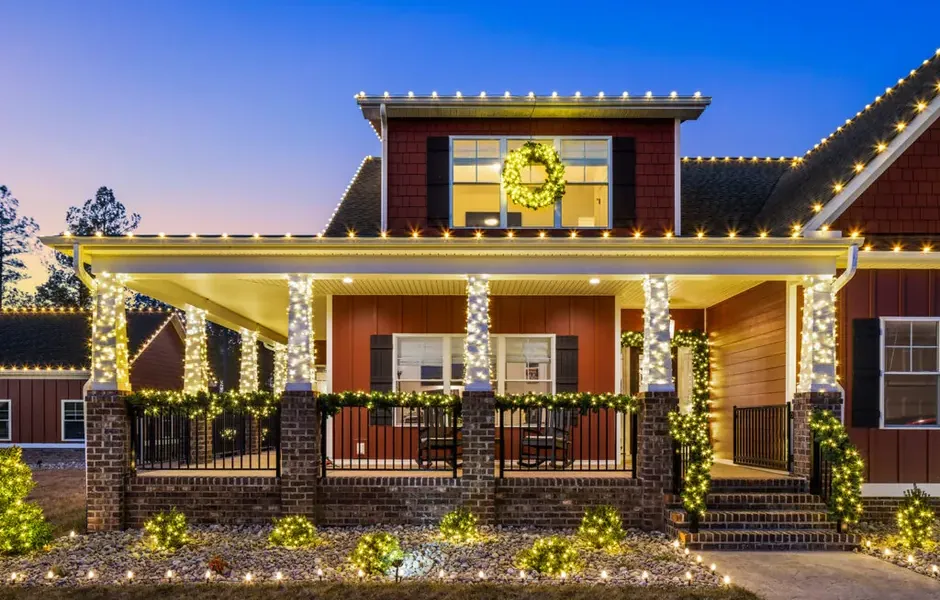
Commercial Christmas light installation is a different job from a house, and treating it like a bigger house is how retail centers end up with a half-lit facade in the second week of December. A business display has to run longer hours, survive a full season without a single visible failure, meet the property’s insurance and safety requirements, and go up without disrupting the tenants underneath it. This guide is for the people who carry that responsibility across metro Atlanta: retail and restaurant owners, office park managers, and HOA boards deciding how the community entrance looks all December.
The short version, if you manage a property: start the conversation in late summer, budget for the season rather than the day, and hire a crew that is insured for commercial work and maintains the display after install. The rest of this guide is the detail behind each of those.
How is commercial installation different from residential?
Three differences drive everything else.
Scale and height come first. A retail center facade, an office building parapet, or a row of mature entrance trees is far more square footage than a single home, and much of it sits at heights that need lifts rather than ladders. That changes the crew, the equipment, and the schedule. A job that would take an afternoon on a house can run several days on a commercial property.
Uptime is second, and it is the one businesses underestimate. A residential display that goes dark for a night is a minor annoyance. A retail display that fails during the shopping season is lost foot traffic during the only weeks of the year that pay for the whole display. Commercial work lives or dies on maintenance, which is why a real commercial installer treats the season, not the install day, as the deliverable.
Coordination is third. Commercial installs have to work around business hours, tenant access, parking, and often a property manager’s approval chain. Our commercial installation service handles that coordination as project management, scheduling around your operating hours so the work does not cost you a single business day.
What kinds of commercial properties do you light?
The commercial category is broad, and each type has its own priorities:
- Retail centers and shopping plazas, where the display exists to pull cars off the road and into the lot during the shopping season.
- Restaurants and hospitality, where warm entrance lighting and lit patios extend the inviting feel that drives holiday reservations.
- Office buildings and corporate campuses, where a clean parapet outline and lit entrance signal a company that pays attention to detail.
- Auto dealerships and car lots, which want high-visibility perimeter lighting that reads from a busy road at 40 miles per hour.
- Venues and event spaces, where the holiday layer often overlaps with the wedding and event lighting a property already books through the winter.
- HOA and community common areas, a category big enough that we run it as a dedicated HOA lighting service: entrance monuments, gatehouses, clubhouse rooflines, and the mature trees that anchor a streetscape.
Each type carries its own priority and its own light-up target, which is worth mapping before you book:
| Property type | What the display is for | Typical light-up target |
|---|---|---|
| Retail center | Pulling cars off the road into the lot | Mid-November |
| Restaurant | Warm entrance and lit patio | Mid-November |
| Office park | Clean parapet, professional entrance | Late November |
| Auto dealership | High-visibility perimeter from the road | Mid-November |
| HOA common area | Board-approved entrance and trees | Thanksgiving |
Across all of them, the product is commercial-grade LED, chosen because it survives extended operating hours and a full Georgia season without the mid-December failures that retail-grade strings are known for. LED also cuts the electricity a large display draws, since the U.S. Department of Energy puts LEDs at least 75 percent below incandescent on energy use, and on a property running lights every night for six weeks that difference is a real line on the utility bill. Entrance trees and streetscape hardwoods usually run through tree wrapping and landscape lighting, which on a commercial site is often the element people actually remember.
How much does commercial Christmas lighting cost?
Commercial displays are quoted per project rather than off a fixed table, because a strip mall, a three-story office, and a neighborhood entrance share almost nothing in scope. The same per-foot logic that prices a home still sits underneath the number, so roofline and perimeter footage, height and rigging needs, tree count, and how many nights the display runs all move the total. Lifts, longer runs, and multi-day crews then build on top of that residential logic, which is why a small storefront can land near a large home while a full retail center is a different order of budget. Our cost factors page walks the same variables on the residential side if you want the underlying logic.
The honest way to budget is to think in seasons, not installs. A commercial quote from us is itemized and covers design, commercial-grade product, installation, in-season maintenance, and January takedown as one number, so there is no surprise bill when a section needs service in the middle of your busiest week. For a firm figure, a site walk is the only real way to price commercial work, and that walk is free. Call or text (470) 777-7443 or request a commercial quote and we schedule it around your hours.
Two things reliably lower a commercial budget without cheapening the result. Booking early captures the same 10 percent early-bird discount homeowners get, applied to a much larger number. And focusing the display where it earns its keep, the road-facing facade and the entrance, rather than lighting every square foot the public never sees, puts the spend where customers actually notice it.
What should an HOA board know before voting?
Boards work differently than homeowners, and a good commercial installer builds for that. The proposal you circulate before a vote should be itemized, should describe the design clearly enough that residents can picture it, and should include the insurance documentation your management company will ask for regardless. We build HOA proposals to be forwarded and voted on without a follow-up call: itemized pricing, a design description, certificates of insurance to the management company on request, and invoicing that runs through the association or property manager.
The timing note matters more for communities than anyone. HOA budgets are usually set over the summer, and approvals take a full board cycle. A community that wants its entrance lit by Thanksgiving needs a proposal in front of the board by early fall, because the approval, the site walk, and a firm install date all have to happen before the calendar fills. Multi-year agreements are worth asking about too, since locking a design spares the board from re-quoting the same entrance every summer.
Why does insurance matter so much for commercial work?
Because the liability sits on your property. A crew working at height on a retail parapet or a clubhouse roofline is exposed to real risk, and if that crew is not properly insured, an accident on your property can become your problem and your property manager’s problem. This is the single most important thing to verify before hiring anyone for commercial holiday lighting, and it is the easiest for a lowball bidder to skip.
Ask for a certificate of insurance before work starts, and confirm the crew is covered for commercial work specifically, not just a residential handyman policy. We carry insurance for common-area and commercial work and provide certificates to property managers as a matter of course, because any commercial client who does not ask should. The cheap bid that cannot produce a certificate is not actually cheaper. It has just moved the risk onto you.
When should a commercial property book?
Earlier than a home, and here is why. A residential install can slot into the calendar with a few weeks of notice in a normal year. A commercial project carries a design-approval step, a site walk, occasionally a property manager or corporate sign-off, and a multi-day install that has to land before the season your tenants or customers expect the lights on. Retail in particular wants the display live in mid-November for the shopping season, which pulls the install into late October or early November.
Stack those steps and the practical deadline for commercial work is late summer. Booking in August or September leaves room for approval, the site walk, and a firm install date, and it captures the November 1st early-bird discount on a large number. Communities and retail centers that wait until October are compressing every one of those steps into the busiest weeks of our year, and the date they wanted is usually already taken. The residential booking guide covers the homeowner version of the same calendar, which is useful if you manage a property and light your own house too.
What does the season look like after install?
The install is the start of the commitment, not the end of it. Through the season, a commercial display is maintained: a dark section on a retail facade gets serviced quickly, from our stock and our lift, because a business cannot afford a visible failure during the weeks that justify the whole display. This ongoing maintenance is exactly what separates commercial-grade service from a crew that hangs lights and disappears until January.
In January, takedown happens on schedule, removed cleanly without leaving clips or damage on your building, and storage is handled so next season starts with a phone call. For a property manager, that arc, one contract covering design through takedown with maintenance built into the middle, is the entire point. It turns holiday lighting from a recurring headache into a line item that simply works. If you want the step-by-step version of how a crew actually works a site, the installation process guide covers it.
Questions property managers and boards ask
How is commercial Christmas lighting different from residential?
Scale, uptime, and coordination. Commercial facades and parapets often need lifts rather than ladders, which changes crew size and turns an afternoon into several days. Uptime matters far more, because a dark retail facade in December costs foot traffic during the only weeks that justify the display. And the work has to schedule around business hours, tenant access, and an approval chain.
When should a commercial property book holiday lighting?
Late summer. A commercial project carries a design-approval step, a site walk, sometimes a corporate or property-manager sign-off, and a multi-day install that has to land before your customers expect lights on. Retail usually wants the display live in mid-November, which pulls installation into late October. Booking by November 1st also captures the 10% early-bird discount.
Do you provide certificates of insurance to property managers?
Yes, as a matter of course. Crews are fully insured for commercial work, and we send certificates to management companies on request. Ask any bidder for one before work starts and confirm the coverage is for commercial work rather than a residential handyman policy. A cheap bid that cannot produce a certificate has moved the risk onto your property, not removed it.
What does an HOA board need in a proposal before voting?
Itemized pricing, a design description clear enough that residents can picture the result, certificates of insurance for the management company, and invoicing that runs through the association rather than an individual. We build proposals to be forwarded and voted on without a follow-up call. Get one in front of the board by early fall, since approvals take a full board cycle.
What happens if part of a commercial display fails in December?
A technician comes out and services it, from our stock and our lift, at no charge. In-season maintenance is written into commercial work rather than sold as a call-out, because a visible failure on a retail facade during the shopping season is the one thing a business genuinely cannot absorb. That ongoing service is what separates commercial-grade work from a crew that hangs and disappears.
We have lit homes and businesses since 2018, more than 7,500 in total, and the commercial side runs on the same principle as the residential side: publish the process, insure the crew, and maintain the display so it never embarrasses you in December. Properties from Atlanta out to Lawrenceville and Decatur all run the same way. More answers sit on our FAQ page, and the main installation service page covers what we supply. If you manage a business, a retail center, an office park, or a community, the next step is a free site walk. Call or text (470) 777-7443, and start the conversation before the summer ends.
Related articles
How Much Does Christmas Light Installation Cost in Atlanta? (2026)
Sep 2, 2026
Lease or Buy Your Christmas Lights? How the Two Models Work in North Atlanta
Sep 2, 2026
Planning Christmas Lights for an Alpharetta Home: HOA Rules, Rooflines, and Timing
Aug 15, 2026