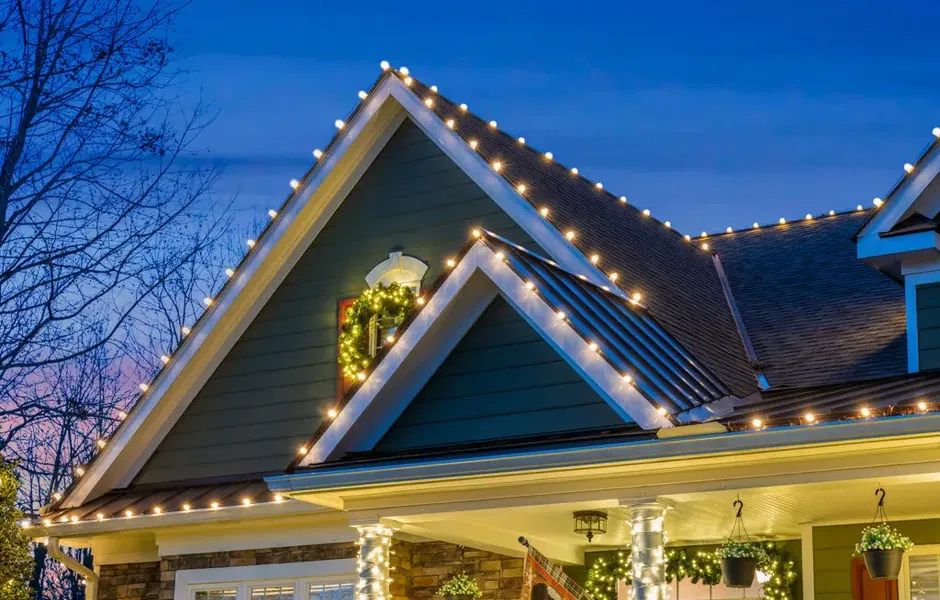
Professional Christmas light installation is five steps: a quote, a design, an install day, in-season maintenance, and a January takedown. You are home for almost none of it. The parts people picture as complicated, the ladder work on a two-story roofline and the wiring that has to survive a Georgia December, are exactly the parts that move to someone else’s problem. This guide walks the whole process start to finish, so you know what actually happens between the phone call and the moment your house lights up on Thanksgiving night.
Here is the sequence at a glance, then each step in detail.
| Step | What happens | Are you involved? |
|---|---|---|
| 1. Quote | Roofline measured, price locked | Briefly, for the walk-through |
| 2. Design | Palette, spacing, add-ons confirmed | Yes, this is your call |
| 3. Install | Crew hangs and tests the display | No, you can be at work |
| 4. Season | Maintenance and repairs as needed | No, we come to you |
| 5. Takedown | Display removed and stored in January | No |
Step one: the quote and the roofline walk
Everything starts with a real number, and a real number needs a measurement. When you request a quote, we measure the roofline you want lit rather than guessing from a photo, because the price is built per linear foot and a guess is how surprises happen. The walk also catches the things that move a quote: home height, the trees you might want wrapped, where power actually runs, and any three-story peak that will need more careful rigging.
A firm quote comes from measured footage, either after you send photos of the front of the house through the contact form or after you book a visit. It is free and itemized, and it locks before any work starts. That itemization matters: a good quote breaks out roofline footage and rate, each tree wrap, and any landscape lighting, and the total does not change after the work is done. Nothing is owed until the display is installed and tested. If you want the full breakdown of what drives the number, our cost guide walks through each factor and how to check it at your own house, and the cost factors service page covers the same ground in shorter form.
Step two: the design
This is the step that is genuinely yours, and it is where a professional install separates itself from a box of store lights. Design means deciding the palette, the spacing, and the proportions, matched to your specific house rather than a generic layout. Warm white on a brick colonial reads completely differently than cool white, and a roofline outlined on both the gutter edge and the peak reads fuller than a single clean run. These are choices, and a good installer walks you through them instead of defaulting to one look.
Design also covers the add-ons that turn an outline into a display. Wrapped trees, the mini-lights spiraled up a maple trunk and into the lower canopy, are the most common, and they run through our tree wrapping and landscape lighting work. Wreaths and garland on the entrance, lit landscape beds, and pathway lighting all get decided here. The point of settling this before install day is that when the crew arrives, there is no improvising on a ladder. The plan is set, the product is cut and prepared for your exact roofline, and the install is execution rather than guesswork. If you want a fully custom look, our custom design service goes deeper on this step.
Step three: install day
Here is what actually happens while you are at work.
An insured crew arrives with the product already prepared for your design. They work the roofline first, clipping commercial-grade LED strings along the edges using clips that grip the shingles or the gutter. This is the detail most people do not know to ask about: a professional install uses no nails and no staples. Nothing punctures your roof or your fascia. The clips hold the strings firmly all season and come off clean in January, leaving no holes behind. Retail installs and rushed handymen are the ones that reach for a staple gun, and a staple in your roofline is a leak waiting for the next hard rain.
The wiring is the other invisible half of the job. Commercial-grade strings use gasketed sockets with replaceable bulbs, so a single failure does not black out a whole run, and the connections are made to shed water rather than trap it. Everything routes to a timer, which is what lets your display run on a schedule without you flipping a switch every night. The crew sets the timer to the light-up date and nightly hours you chose, then tests the entire display before they leave. Nothing gets called finished until every section is confirmed lit.
Two-story and three-story work is slower and more careful, which is the honest reason height carries a price factor. A tall gable over a garage looks simple from the ground and is genuinely dangerous from a ladder, and it is the single most common reason metro Atlanta homeowners stop doing this themselves. The crew has the taller ladders, the fall protection, and the experience to work those heights safely, so you are not the one 20 feet up on a cold Saturday.
Can the lights be installed before I want them on?
Yes. The crew can hang your display in late October or early November and leave it dark on a timer until the night you pick, so booking early never means a too-early house. That timer is set during install day and simply does not switch on until the date you choose. Our booking-timeline guide covers the scheduling side in full, month by month, including why September is when the good dates go.
Step four: the season and what happens if something fails
Even commercial-grade product can take a hit from a hard freeze or a windstorm, and occasionally a section goes dark in the middle of December. On a professional install, that is not your problem to diagnose. A dark section gets fixed from our stock, on our ladder, at no charge, because in-season maintenance is part of the package rather than a service call you dread.
This is the difference that justifies the price over a DIY roofline. When store-bought strings fail mid-season, and they fail at roughly ten times the rate of commercial product, you are the one back on the ladder in the cold trying to find the dead bulb. Our half-out diagnosis guide exists because that hunt is genuinely tedious. When a professional display has an issue, you make one call and it gets handled. The whole season is covered, not just the day the lights went up. Our honest DIY versus professional comparison breaks down exactly where that reliability gap comes from.
Step five: takedown and storage
In January, the crew comes back and removes the display. This is the step homeowners forget to price when they compare a professional install to doing it themselves, and it is a real one. Taking down a two-story roofline is the same ladder work as putting it up, in colder weather, at the least festive time of year. On a professional install it simply happens on schedule, included in the season price rather than sold separately.
What happens to the lights next depends on your model. On the lease package, the strings go back into our storage until next season, so your garage never fills with bins and your attic never bakes a tangle of cords through a Georgia summer, which is genuinely hard on wire insulation. If you own your lights, we still handle off-season takedown and storage unless you’d rather keep them, so next year starts with a phone call instead of untangling last year’s knot. Either way, the clips come off clean and your roofline looks like nothing was ever there.
What do I actually have to do?
Very little, which is the point. Your whole share of the work is three decisions:
- Take the quote walk, or send photos of the front of the house and let the measurement come back to you.
- Make the design choices: palette, how many runs, which trees, what happens at the entry.
- Pick the light-up date and the nightly hours.
After that, the crew handles the ladders, the wiring, the timer, the mid-season repairs, and the January takedown. You get a display that goes live by itself on the night you chose and comes down on schedule without you touching it.
Common questions about the installation process
Do I need to be home when the crew installs?
No. Once the design is settled and the quote is signed, install day runs without you. The crew arrives with product already cut for your roofline, works the roof and the trees, sets the timer, tests every section, and leaves. Most customers are at work. You only need to be present for the quote walk and the design conversation, and even that can happen from photos.
Do you use my lights or your own?
Ours. Commercial-grade LED strings are supplied and custom-cut to your measured roofline rather than joined from retail lengths, because the connectors between store-bought strings are what fail first in a wet December. The strings use gasketed sockets with replaceable bulbs, so a single failure does not black out a whole run and a mid-season repair is quick.
Will the install damage my roof?
No. Clips grip the shingle edge, the gutter lip, or the trim and carry the string without piercing anything. There are no nails and no staples, so nothing punctures the roof or the fascia. In January the clips come off with the lights and there are no holes left behind. A staple in a roofline is a leak waiting for the next hard rain.
Can the lights go up early and stay dark until Thanksgiving?
Yes, and most people do it that way. The crew can hang the display in late October or early November and set the timer to the night you picked, so the house stays dark until then and lights itself on schedule. Booking early never means a too-early house. Installs run from late October through mid-December.
What if something fails in the middle of December?
You make one call and a technician comes out. In-season service is included, not billed as a call-out, and the repair uses matching stock from the same batch so the fixed section does not read differently from the rest of the run. Hard freezes and windstorms are the usual causes, and neither is something you should be diagnosing on a ladder.
We have run this exact process across 7,500+ homes since 2018, and it does not change much from Alpharetta to Woodstock to Johns Creek. The house is different, the roofline length is different, the design is yours, but the five steps hold. More answers live on our FAQ page. If you want to start, a free itemized quote through our installation service or a call or text to (470) 777-7443 locks your price and your date. Book by November 1st and the 10% early-bird discount comes off the top.
Related articles
How Much Does Christmas Light Installation Cost in Atlanta? (2026)
Sep 2, 2026
Lease or Buy Your Christmas Lights? How the Two Models Work in North Atlanta
Sep 2, 2026
Planning Christmas Lights for an Alpharetta Home: HOA Rules, Rooflines, and Timing
Aug 15, 2026