The gear that keeps you off the ladder
Nothing on this page changes how your display looks. All of it changes how likely you are to get hurt putting it up, which is the part of this job worth spending money on.
As an Amazon Associate, Christmas Lights North Atlanta earns from qualifying purchases. The product links on this page are affiliate links - it costs you nothing extra, and it does not change what we recommend.
Everything else on this site is about how a display looks. This page is about not getting hurt, so it is the one we would most like people to read.
Falls from ladders are why this trade exists. They do not usually happen because someone was careless. They happen because a ladder was leaned on a gutter that gave slightly, or because somebody reached three feet sideways rather than climbing down and moving it for the fifteenth time that afternoon.
Two purchases genuinely change those odds.
A hanging pole
A telescoping pole with a hook on the end lets you push a clipped string up onto an eave and seat it from the ground. On a single-story house it can replace the ladder for most of a run. On a two-story it will not do everything, but it removes a large share of the ladder moves, and it is the repeated moving, and the reaching to avoid moving, where the risk concentrates.
Buy for your eave height plus a couple of feet of margin. Working at full extension is where poles flex and stop being precise, and a hook that wanders will not seat a clip. Carbon fiber costs more and is worth it above about fifteen feet purely on weight.
A ladder standoff
A standoff bolts to the ladder and holds it off the wall, spreading the load onto the roof edge or wall face rather than the gutter. Leaning an extension ladder directly onto a loaded gutter is common and is a genuinely bad idea: the gutter deforms, and a gutter that deforms lets the ladder move.
It also gives you a working position at the eave where you are square to the work rather than leaning around the rails.
A tester, for after
Not a safety item, but the tool that most reliably saves money. One dead bulb or a blown plug fuse can take out a whole section of an LED string, and without a tester the usual response is to throw the string away. A tester finds the fault in about a minute; see half a string out for how to use one.
The part no tool fixes
If your roof is steep, if your plan needs you standing on the roof rather than working from the edge, or if the house is three stories, no pole or standoff makes that a reasonable afternoon. Our crews use roof anchors and harnesses on houses like that.
Our DIY-or-pro wizard is honest about where that line sits, including the many cases where the answer is that you should simply do it yourself.
Hanging poles: the one purchase that keeps you off the ladder
A telescoping pole with a hook lets you seat clips along an eave from the ground. On a single-story house it can replace the ladder entirely; on a two-story it removes most of the ladder moves, which is where the risk actually is.
| Product | Reach | Brand | Price |
|---|---|---|---|
| 4-12 ft Long Telescopic Extension Pole & Utility Hook for Christmas Lights | 4 to 12 ft | EXTEND-A-REACH | $39.97 |
| 5-24 ft Long Telescopic Extension Pole & Utility Hook for Christmas Lights | 5 to 24 ft | EXTEND-A-REACH | $69.97 |
| DOBEN 4.7-24 FT Carbon Fiber Telescoping Christmas Light Hanging Pole | 4.7 to 24 ft | DOBEN | $80.74 |

4-12 ft Long Telescopic Extension Pole & Utility Hook for Christmas Lights
Twelve feet handles a single-storey eave and most gable ends. The right pick if your house is one storey and you only want to stop dragging the ladder along the wall.
$39.97
See it on Amazon
5-24 ft Long Telescopic Extension Pole & Utility Hook for Christmas Lights
Twenty-four feet of reach means a second-storey eave from the ground. If this pole keeps you off a ladder even once, it has paid for itself several times over.
$69.97
See it on Amazon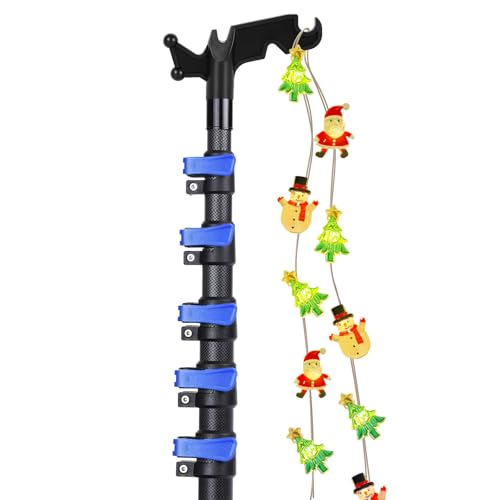
DOBEN 4.7-24 FT Carbon Fiber Telescoping Christmas Light Hanging Pole
Carbon fibre instead of aluminium, which matters more than it sounds: at 20 feet of extension the weight is what makes a pole wander, and a wandering hook will not seat a clip.
$80.74
See it on AmazonLadder standoffs
A standoff holds the ladder off the gutter and spreads the load onto the roof edge or the wall. Leaning a ladder straight onto a loaded gutter crushes the gutter, and a crushed gutter is how the ladder moves.
| Product | Brand | Price |
|---|---|---|
| Ladder Stabilizer | Foozet | $41.99 |
| Ladder-Max Ladder Stabilizer | Ladder-Max | $129.99 |

Ladder Stabilizer
The budget standoff, aluminium with a non-slip pad. Any standoff beats no standoff — this is the version to buy if the American-made one is more than the job is worth.
$41.99
See it on Amazon
Ladder-Max Ladder Stabilizer
A standoff holds the ladder off the gutter and spreads the load onto the roof edge or wall. Leaning a ladder directly on a loaded gutter is how people crush the gutter and fall.
$129.99
See it on AmazonTesters and repair tools
One dead bulb can take out half a string. A tester finds it in about a minute and turns a set you were going to throw away into a working one, which is cheaper than replacing it and keeps a working string out of landfill.
| Product | Brand | Price |
|---|---|---|
| allsun GK13 Holiday Light Repair Kit, BT20 Battery Tester & 50 Bulbs | allsun | $20.99 |
| Light Keeper Pro-The Complete Tool For Fixing Your Christmas Lights | LIGHT KEEPER PRO | $37.90 |

allsun GK13 Holiday Light Repair Kit, BT20 Battery Tester & 50 Bulbs
A tester, fuse checker and non-contact voltage pen in one kit. The voltage pen is the part worth having anyway — knowing a cord is live before you handle it in the wet is basic safety.
$20.99
See it on Amazon
Light Keeper Pro-The Complete Tool For Fixing Your Christmas Lights
The classic tool for finding the one dead bulb taking out half a string. Cheaper than replacing the set, and it turns a thrown-away string into a working one in about a minute.
$37.90
See it on AmazonPrices checked Sep 24, 2026 and may change. As an Amazon Associate, Christmas Lights North Atlanta earns from qualifying purchases. We only list gear we would put on a customer's house; we buy our own commercial stock through distributors, not Amazon, so treat these as the closest equivalents a homeowner can actually order.
Tools and safety questions
Can you hang Christmas lights without a ladder?
On a single-story house, largely yes. A telescoping pole with a hook lets you seat clips along an eave from the ground, and a 12-foot pole reaches most single-story eaves and gable ends. On a two-story house a longer pole removes most of the ladder work but rarely all of it, particularly at the peaks.
What length hanging pole do I need?
Match it to the eave height, which is roughly 12 feet on a single-story house and 22 feet on a two-story. Add a couple of feet so you are not working at full extension, since a fully extended pole flexes and a flexing hook will not seat a clip. A 4 to 12 foot pole suits single stories; two-story work wants something reaching 20 feet or more.
What does a ladder standoff actually do?
It holds the top of the ladder away from the wall and spreads the load onto the roof edge or the wall face instead of the gutter. That matters for two reasons: a loaded gutter can crush and let the ladder move, and a standoff gives you a stable working position at the eave rather than leaning sideways around the ladder rails.
Is a carbon fiber pole worth the extra over aluminum?
At full extension, yes. Weight is what makes a long pole wander at the tip, and a wandering hook cannot seat a clip on a shingle you are twenty feet below. If you are only ever working at ten or twelve feet, aluminum is fine and cheaper.
How do I find one dead bulb in a string?
A light tester. On LED strings a single failed bulb or a blown fuse in the plug can take out a whole section, and a tester finds it in about a minute. It turns a set you were about to throw away into a working one, which is both cheaper and less wasteful than replacing the string.
What is the safest way to work on a ladder in December?
Have someone hold the base, set it at about a 4:1 ratio (one foot out for every four feet of height) on firm level ground, keep your hips between the rails rather than reaching sideways, and move it rather than stretching. Do not work on a ladder in wind or on frost, and if the roof itself is steep or you would need to stand on it, that is the point to stop and call a pro.
Or skip the ladder entirely
Our crews work at height every day with the right access equipment. If the roofline is the part you are unsure about, that is exactly the part worth handing over.